Backyard Offices & Studios
Backyard Office Sheds: Custom-Built vs Prefab Pods & Costs
A backyard office shed fixes the problem a spare-room desk never quite does: work happens at home, but not in the home. Thirty seconds of commute, a door that closes, and video calls that don’t feature your laundry.
- Vetted local builders
- Free quotes
- 24–48h response
The decision that actually matters isn’t whether to get one. It’s which kind: a prefab pod shipped from a factory, or a custom backyard office shed put up by a local pro. The pod companies won’t give you a straight answer on that, and neither will the shed dealers.
We match homeowners with vetted builders in all 50 states, so we’ve seen both paths up close. Here’s the honest version, with the numbers everyone else leaves out.
Can a shed be used as an office?
Yes. A shed becomes a real office with four upgrades: insulation, electricity, internet, and heating or cooling. Skip any of them and you have a summer shed with a desk in it. Build them in from the start and you have a year-round workspace that costs a fraction of a home addition.
That “from the start” part is the whole game. Retrofitting a storage shed into an office costs more than ordering the building office-ready, and it never comes out quite as clean.
Custom-built vs prefab pod: which backyard office should you get?
This is the fork in the road, so let’s put the two options side by side before anything else.
| Custom-built shed office | Prefab office pod | |
|---|---|---|
| Built | On-site or delivered by a local builder | Factory-made, shipped, craned or assembled |
| Typical timeline | 4–5 weeks turnkey; 1–3 days for panel assembly | 2–8 weeks lead time, 1–3 days install |
| Customization | Any size, siding, roofline, window layout | Fixed models and floor plans |
| Site limits | Fits tight yards; built where it stands | Needs delivery access; gates, wires, and slopes matter |
| Matching your house | Yes, siding and roof to match | Modern look, take it or leave it |
| Future flexibility | Can be spec’d ADU-ready | Harder to modify later |
| Price transparency | Local quotes, itemized | Often quote-only; premium positioning |
When a prefab office pod makes sense
You want a modern-looking box, fast, and your yard has clean delivery access. A backyard office pod is purpose-built for work: insulation, wiring channels, and big windows come standard, and the look is sharp. The trade-offs are fixed floor plans and premium pricing that most pod makers won’t publish until you’re deep in their configurator.
Delivery is the quiet dealbreaker. A prefab backyard office arrives as a finished unit or large panels, which means gate width, overhead wires, slopes, and crane reach all matter. Pod companies also ship to limited zones, so depending on your state, the sleek pod you configured may not deliver to you at all.
When a custom-built office shed wins
You want the building to match your house, fit an odd corner of the yard, or grow into something more later: a guest room, a studio, an ADU. You want an itemized local quote instead of a configurator total. Or your yard simply can’t take a crane delivery.
A custom build through a local pro handles all of it, and you’re not paying freight on a finished box. It also gets built for your climate rather than a national spec sheet. A builder in Minnesota frames for snow load and insulates the floor without being asked; one in the Gulf South ventilates for humidity. That local judgment is the lane our cabin and studio builders work in.
How much does a backyard office shed cost?
Here’s the number most guides dance around. The building is only part of the bill, and often not the biggest part. Two published anchors set the honest range: Wright’s Shed Co. lists office-ready shells and kits from about $2,100 to $14,000, while Backyard Unlimited quotes $20,000 to $40,000 for a finished 10×16 studio with standard features. Both are right. They’re pricing different amounts of “done.”
The all-in picture for a custom build:
| Line item | Typical range |
|---|---|
| Building shell (8×10 to 12×16, office-ready) | $2,100 – $14,000 |
| Foundation (gravel pad to concrete slab) | $1,000 – $5,000 |
| Electrical run + hookup (licensed electrician) | $1,000 – $3,000 |
| Mini-split heating/cooling | $1,500 – $4,000 |
| Permits | $100 – $500 |
| Realistic all-in | $5,700 – $26,500 |
Fully finished turnkey builds (drywall, flooring, paint, everything done for you) land in that $20,000 to $40,000 band. Prefab pods generally price against the turnkey end, not the shell end.
The costs nobody quotes
Foundation, electrical, and climate control add $3,500 to $12,000 on top of any shell price you see advertised. That’s the gap between the price on the website and the price of a working office. When builders in our network quote an office project, the shell is sometimes less than half the invoice. Budget that way from day one and nothing about the project will surprise you.
Spreading the cost is also an option most buyers don’t know about: many builders offer rent-to-own and financing on the building itself, with no credit check.
Foundation options: gravel pad, footers, or slab
Three foundations cover nearly every office build, and Backyard Unlimited’s guidance matches what our builders say. A gravel pad is the budget-friendly default: fast to install, drains well, and fine for most delivered buildings. Concrete footers step up the permanence for larger structures or sloped sites. A full concrete slab costs the most and takes the longest to cure, but it gives you the most solid, level floor and the cleanest path to a finished interior.
Which one you need depends on your soil, your slope, and your building size. It’s a five-minute conversation with a local builder and a very expensive thing to get wrong on your own.
What size backyard office do you need?
The popular sizes, and who they actually fit:
- 8×10 (80 sq ft) — one person, one desk, essentials only. Often small enough to skip a building permit.
- 10×12 (120 sq ft) — the sweet spot. Desk, storage, a chair for a second person, room to roll your chair back without hitting a wall.
- 12×16 (192 sq ft) — two workstations, or one office with real storage or a small sitting area.
A sizing rule that holds up: start with about 30 square feet of core workspace, add 20 to 30 for the desk setup, 10 to 15 for storage, then add 20% for circulation so the room doesn’t feel cramped. A single-person office with storage pencils out to roughly 85 square feet, which is why the 10×12 is the size builders order most for offices.
Ceiling height and window placement shape how the space feels more than the footprint does. North-facing windows give steady, glare-free light for screen work; east-facing suits early starters; west-facing brings afternoon glare right when you’re trying to finish the day. Worth orienting the building around.
Design options go further than most buyers expect: transom windows over the door, double doors, porches, dormers, interior lofts for storage, and siding matched to your house. This is custom-build territory. A pod gives you the options on the order form; a builder gives you whatever your yard and budget allow.
Do you need a permit for a backyard office shed?
Usually, yes. Because of the wiring, not the walls. The common thresholds:
- Under 120 sq ft: many jurisdictions skip the building permit for the structure itself, but adding electrical almost always requires an electrical permit.
- 120–200 sq ft: a basic building permit in most areas.
- Over 200 sq ft: full permits, plan review, inspections.
- Any plumbing: permits, full stop, and often a different structure classification.
Setbacks matter too: most areas want the building 5 to 10 feet off property lines, and HOAs can be stricter than the county, so check both. Rules change block by block, which is exactly why we match you with a local builder who has pulled permits in your county before. Ask them what your project needs before you fall in love with a floor plan.
Insulation, electricity, and internet: making it year-round
The difference between a backyard office and an expensive shed is what’s in the walls.
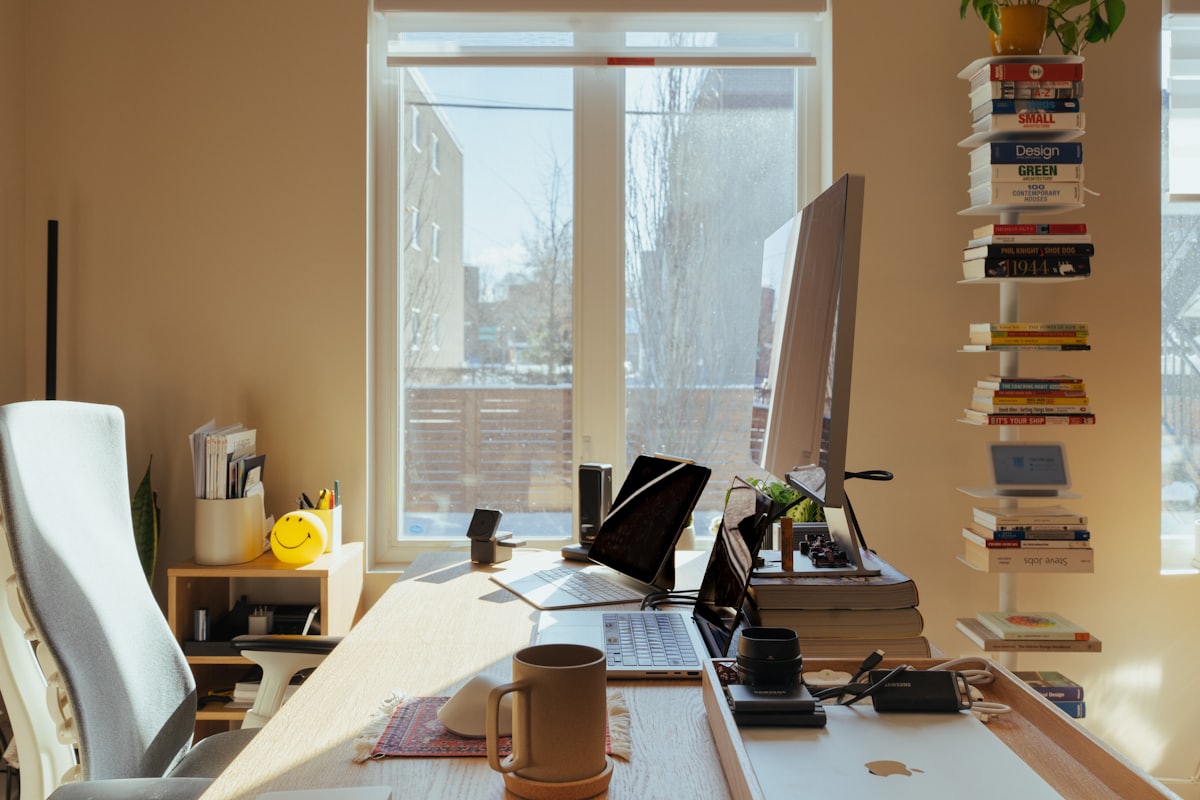
Insulation. For year-round comfort, aim for at least R-13 in the walls and R-19 in the ceiling. Premium builds go much further: Modern Shed offers up to R-27 walls and R-60 roofs. Insulate the floor too. Cold feet in January will drive you back to the kitchen table.
Match the spec to your climate while you’re at it. A Phoenix office lives or dies by shade and cooling capacity; a Vermont office needs that floor insulation and a heat source sized for real winter. A national kit ships one answer; a local builder specs for your weather.
Soundproofing. If your work is calls, say so up front. Insulation already dampens a lot, and builders can add solid-core doors, double-pane windows, and denser wall assemblies that keep the lawnmower next door out of your meetings. This is much easier to build in than to bolt on.
Electricity. Power runs from your house panel through an underground conduit, installed by a licensed electrician. Plan outlet placement around your actual desk layout before the walls close up, and have the builder include a small subpanel if you’re running heat, AC, and a workstation.
Internet. The reliable answer is a hardwired ethernet line pulled through the same trench as the power. It costs almost nothing extra during the build and beats every wifi extender ever made. Mesh systems work as a fallback for short runs.
Climate control. A ductless mini-split handles both heating and cooling and sips power. It’s the default answer for a reason. Space heaters and window units are what retrofits settle for.
Are backyard office sheds worth it?
For daily remote workers, the math tends to work. Wright’s Shed Co. reports basic office sheds returning 50 to 80% of their cost in added home value, with high-end builds recouping the full investment. That’s before counting what the separation does for your workday. And a dedicated structure outlasts job changes: today’s office is tomorrow’s guest room, gym, or studio.
Where it doesn’t add up: if you work remotely one day a week, or the budget only covers a bare uninsulated shell, the money is better parked until it covers the real thing. An office you can’t use in February isn’t an office.
The honest middle: buy the size you need, not the size that impresses. A finished 10×12 beats an unfinished 12×20 every single time.
Backyard office shed FAQ
Is it cheaper to buy a shed or build a shed?
Buying a prefab shell is usually cheaper and always faster than stick-building from scratch, because factory panels compress labor from weeks to days. DIY from raw lumber only wins if your time costs nothing and the tools are already in your garage. Either way, the shell is the smaller half of an office budget; the site work is where the money goes.
Can a she shed be used as a home office?
Yes. Same building, different furniture. The upgrades that matter are identical: insulation, power, internet, climate. Spec those from the start and the space handles both jobs without compromise.
Are big-box office shed kits worth it?
Kits from Costco, Home Depot, and other big-box retailers are storage sheds at heart: thin walls, no insulation, no wiring. By the time you’ve retrofitted one into a real workspace, you’ve usually spent custom money on a kit-grade building. A smaller custom shed built office-ready beats a bigger kit that isn’t. That’s no knock on kits for storage; it’s just not what they’re for.
Can you add a bathroom to a backyard office?
Yes, and experienced builders handle it regularly, but plumbing reclassifies the project. Expect more permits, inspections, and the cost of trenching water and sewer. Decide up front; retrofitting plumbing is the most expensive way to get it.
How long does a backyard office take to build?
Prefab panels: 1 to 3 days of assembly once the foundation is in. Turnkey on-site builds: typically 4 to 5 weeks start to finish. Permits add lead time that varies by county, so start the paperwork before the build slot.
Ready for a real number instead of a configurator estimate? Tell us your size, your state, and how you’ll use it, and we’ll match you with a vetted local builder who does office builds every month. Get your free quote and a local pro gets back to you within 24 to 48 hours. No pressure, no obligation.